Battery bank review · US edition
Fortress Power eVault MAX review
An 18.5 kWh floor-standing battery. The inverter and physical installation deserve as much attention as capacity.
On this page
Our take
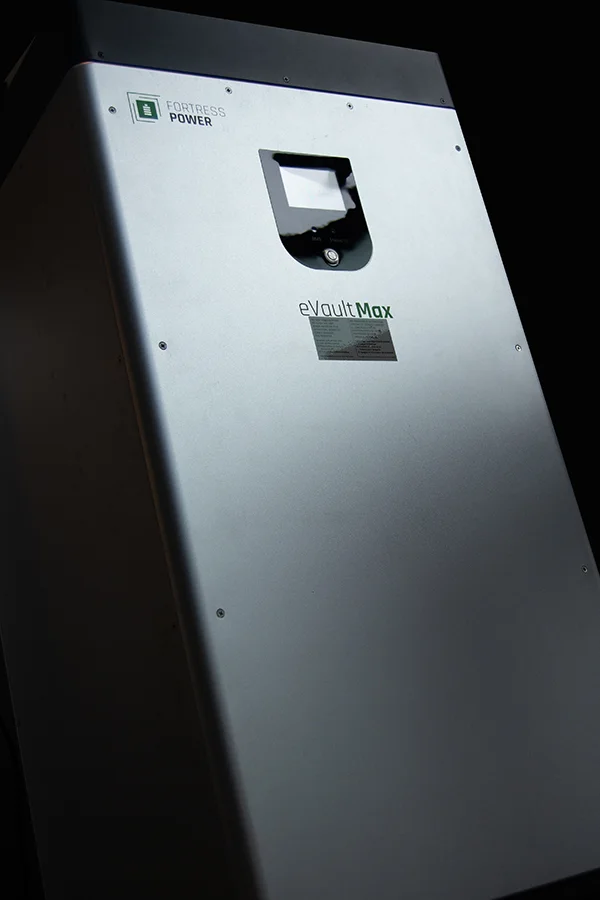
The eVault MAX suits projects that need a substantial DC battery bank and have space for a heavy floor-standing enclosure. Its capacity is attractive for longer-duration designs, but it does not tell you the household power output. That comes from the complete battery-and-inverter pairing. The strongest proposal will show why this large enclosure suits the site better than a modular stack or several smaller batteries.
eVault MAX at a glance
Check the model in your quote against these published details.
| Nominal energy | 18.5 kWh [1] |
|---|---|
| Battery type | 51.2 V nominal, LFP [1] |
| Published weight | 520 lb [1] |
| Enclosure | IP55; installation requirements apply [1] |
| Limited warranty | 10 years; check operating and service terms [1] |
Capacity, continuous output and peak output measure different things. Compare like-for-like values for the complete configuration.
What is included in the system?
The eVault MAX is the energy store in a system that also needs an inverter, controls and electrical protection. Fortress publishes inverter integration information; your installer should use the instructions for the exact pairing. Battery communications are part of that design. A list of compatible brands is less useful than the inverter model and commissioning settings actually being supplied.
Conceptual energy flow. The equipment and connections depend on the installation.
What can it power during an outage?
Size the battery bank and the inverter together. A large store of energy can still feed an inverter with a relatively modest AC output. Conversely, a large inverter must be supported by enough battery discharge capability. Ask for separate figures for usable energy, continuous household output and starting loads, with an example based on the circuits you plan to keep running.
A high power rating does not guarantee a long runtime. Backup duration also depends on charge level, reserve settings, appliance use and available solar.
Existing solar and future expansion
Adding storage to a home with panels
Existing solar compatibility is primarily an inverter and control question. The eVault does not by itself establish whether an existing solar inverter can remain, operate off-grid or recharge the battery during an outage. Have the installer map those connections and explain any replacement equipment before accepting a broad retrofit claim.
Planning for more capacity
Fortress describes parallel expansion, but a homeowner should begin with a realistic site plan. Each additional enclosure brings weight, floor area, cables and protection. Confirm the permitted battery mix, communications topology and inverter limits before assuming future capacity can simply be plugged in. The theoretical maximum is rarely a useful residential target.
The advantages and the trade-offs
Reasons to shortlist it
- 18.5 kWh nominal storage in one enclosure.
- LFP chemistry and a documented parallel expansion path.
- Separate inverter selection allows a system to be designed around the project.
What to weigh up
- At 520 lb, delivery and placement require planning.
- The battery needs a compatible inverter to serve household AC loads.
- eVault MAX specifications should not be applied to the different eForce range.
Warranty, monitoring and support
Keep the warranty revision for eVault MAX, rather than a general Fortress brochure. Arrange a service contact who supports both the battery and its inverter. Because moving this enclosure is significant work, ask how access, removal and replacement are handled if service is required. The physical route into the property matters for aftercare as well as initial installation.
A useful handover includes your equipment schedule, the applicable warranty documents, homeowner access to monitoring and a named service contact. Ask the installer to demonstrate the operating mode you are buying.
What affects the installed cost?
Compare installed capacity after including the inverter, battery protection, mounting or floor preparation, delivery handling and commissioning. A difficult access route or unsuitable floor can change the project. A quote for an eVault battery alone leaves those practical costs unresolved, even when the hardware capacity looks attractive.
| Equipment | Battery quantity, inverter, gateway or transfer equipment and mounting |
|---|---|
| Electrical work | Panel changes, cable routes, protection and backed-up circuits |
| Delivery | Permits, installation, commissioning and monitoring handover |
| Aftercare | Workmanship cover, diagnostic visits and replacement labor |
Is eVault MAX right for your home?
Shortlist eVault MAX for a site with suitable access and room for a floor-standing battery, backed by an installer experienced with the proposed pairing. Compare a smaller modular system if access is tight or you expect to expand in small increments. Capacity is a reason to investigate it, not a substitute for a site-specific design.
Compare an actual installation.
Take these questions to an installer and get a design for your home.
Your questions, answered
Does eVault MAX include the household inverter?
No. It is a DC battery that must be paired with compatible conversion and control equipment.
Is eForce the same product?
No. eForce is a different Fortress family; compare its own specifications and installation requirements.
Can it back up the whole home?
That depends on the battery bank, inverter, switching arrangement and household loads. Ask for a documented load assessment.
Sources and review method
This is a research-based assessment of published manufacturer information, not a hands-on laboratory test or an owner-review average. Our judgments explain the buying implications of the equipment and its limitations. We do not assign star ratings, invent installation prices or infer local installer availability from a product page.
Check the current US model, configuration and warranty before ordering. Where regional compatibility or terms could not be established, we say so in the review. Shortlist Solar is an installer referral service; a quote request is optional and subject to participating-installer availability.