Battery bank review · US edition
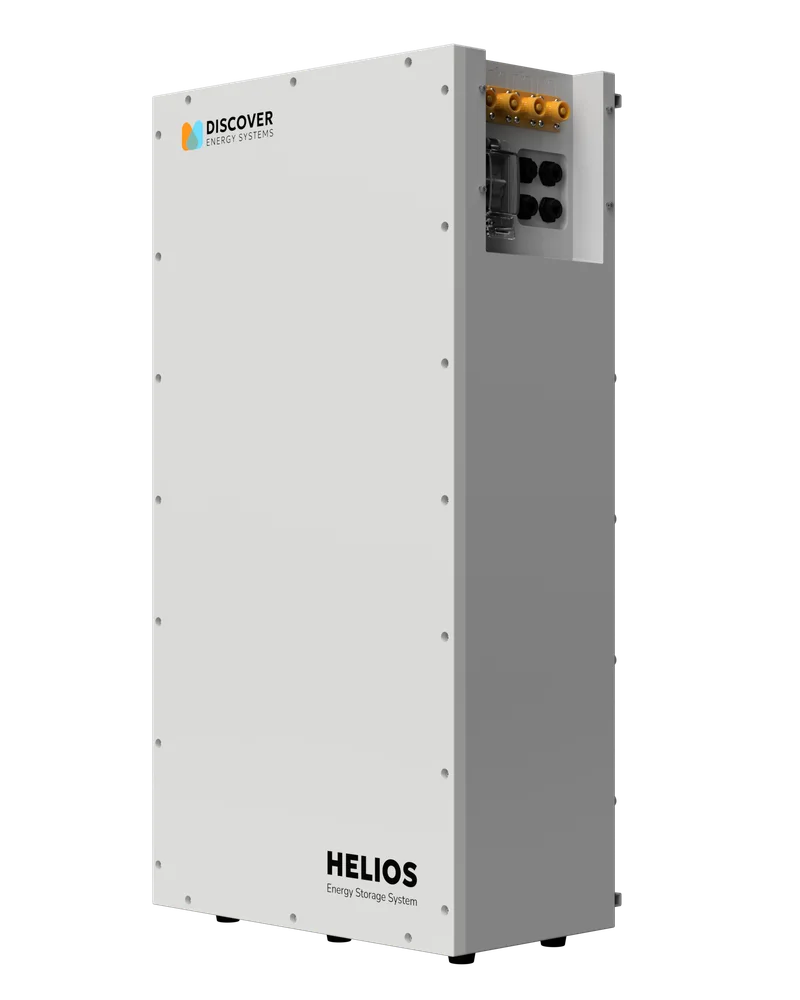
Discover Energy Systems HELIOS ESS review
A 16 kWh battery with inverter communications. Verify the complete system combination against current documentation.
On this page
Our take
HELIOS ESS is worth researching for a battery-bank design where the installer supports the selected inverter and communication setup. Its substantial nominal capacity is useful for a longer-duration plan. The buying decision should also include the current installation and certification documents for the exact pairing; a battery product page alone does not establish approval for every system.
HELIOS ESS at a glance
Check the model in your quote against these published details.
| Product model | HELIOS ESS 52-48-16000 [2] |
|---|---|
| Nominal energy | 16 kWh [1] |
| Chemistry | LFP [1] |
| System integration | Supported inverter communications; check the exact pairing [1] |
Capacity, continuous output and peak output measure different things. Compare like-for-like values for the complete configuration.
What is included in the system?
HELIOS ESS supplies DC storage and communicates with supported system equipment. The inverter performs household power conversion. A complete proposal should identify the battery model, inverter, communications arrangement and protection. The installation manual’s system guidance matters because approval and operation concern the combination, not simply one enclosure.
Conceptual energy flow. The equipment and connections depend on the installation.
What can it power during an outage?
Ask for the AC output of the complete pairing and the backed-up circuit schedule. The battery bank needs sufficient discharge capability for the inverter and loads. More stored energy can extend duration, while output and motor starting remain separate constraints. Confirm how the system responds when battery charge approaches its minimum operating level.
A high power rating does not guarantee a long runtime. Backup duration also depends on charge level, reserve settings, appliance use and available solar.
Existing solar and future expansion
Adding storage to a home with panels
Existing solar compatibility depends on the chosen inverter and controls. Have the installer show whether the existing solar equipment remains and how generation is managed during an outage. Do not infer compatibility from a partner-logo list; the model, firmware and installation arrangement need to match current guidance.
Planning for more capacity
Plan an expanded bank using the manufacturer’s supported configuration and the inverter’s limits. Record communications and protection requirements as well as physical space. Future additions may need recommissioning and updated compatibility checks. A larger bank is only useful if the rest of the installation can manage it as intended.
The advantages and the trade-offs
Reasons to shortlist it
- Published 16 kWh nominal storage.
- LFP battery architecture.
- Manufacturer documents inverter communications and installation configurations.
What to weigh up
- A separate compatible inverter is required.
- Battery-bank energy and household output are different limits.
- HELIOS and Discover’s other battery families have different documents and requirements.
Warranty, monitoring and support
Request the HELIOS warranty, current manual and commissioning record. Discover’s other product families should not be used as substitutes for those documents. Establish who diagnoses a problem involving battery communications or inverter control, and how replacement labor is treated. Keep homeowner monitoring access and a named service contact.
A useful handover includes your equipment schedule, the applicable warranty documents, homeowner access to monitoring and a named service contact. Ask the installer to demonstrate the operating mode you are buying.
What affects the installed cost?
Compare the HELIOS bank, inverter, controls, mounting and installation together. Site access, electrical protection and commissioning are part of the purchase even when the battery arrives as one enclosure. Ask for any expansion provisions or optional monitoring hardware to be shown separately.
| Equipment | Battery quantity, inverter, gateway or transfer equipment and mounting |
|---|---|
| Electrical work | Panel changes, cable routes, protection and backed-up circuits |
| Delivery | Permits, installation, commissioning and monitoring handover |
| Aftercare | Workmanship cover, diagnostic visits and replacement labor |
Is HELIOS ESS right for your home?
Consider HELIOS where the installer can provide a supported system design and clear aftercare. It is a component-level choice that should be assessed alongside the inverter. If the proposal relies on a broad approval claim, ask for the current documentation covering the exact equipment combination before proceeding.
Compare an actual installation.
Take these questions to an installer and get a design for your home.
Your questions, answered
Is HELIOS the same as Discover AES batteries?
No. They are different product families; use HELIOS-specific documents.
Does 16 kWh describe power output?
No. It describes nominal stored energy. The complete battery-and-inverter system determines household output.
Does a battery listing approve every inverter combination?
No. The installer must check the current documentation and requirements for the complete proposed system.
Sources and review method
This is a research-based assessment of published manufacturer information, not a hands-on laboratory test or an owner-review average. Our judgments explain the buying implications of the equipment and its limitations. We do not assign star ratings, invent installation prices or infer local installer availability from a product page.
Check the current US model, configuration and warranty before ordering. Where regional compatibility or terms could not be established, we say so in the review. Shortlist Solar is an installer referral service; a quote request is optional and subject to participating-installer availability.